Category Archives: Director

TACTICS: gettin’ intersectional

I have learned so much this week from curating an interview series on the Works by Women San Francisco site, TACTICS: Theatre Artists’ Collected Thoughts Insights Challenges and Strategies for gender parity advocacy.

I expected to learn a lot about what individual advocates have been doing for decades, what the idea of gender equity has been doing for centuries, and what new initiatives are popping up now in the age of technology and constant connection. I did not expect to learn how easy it is to be blind to your own biases, even when you think you’re aware of them.

The first eight TACTICS profiles we posted are stellar. I am very proud of the series so far, and very excited about the pieces that are still in the pipeline. The interviews feature a mix of longtime advocates, artistic directors, and individual artists. I was pleased to notice that they feature women from different generations and a couple of LGBT voices. I also noticed that these wonderful, intelligent, articulate, passionate women all happen to be white.

Happen to be. This is the phrase that artistic leaders use when they’re excusing their season of plays that happen to be written by, directed by, designed by, and starring mostly white men over 40. This is the phrase they use when they want to say “I don’t want gender and race to interfere with my artistic choices.” This is the phrase that suggests that women and people of color just aren’t making the kind of work that the artistic director wants to do at his/her theatre – it won’t resonate with their subscribers, or it’s not good enough.

I didn’t intend to interview mostly white advocates for gender parity. Going in, I was even consciously aware of this long-standing bias in the feminist movement. I deliberately brainstormed women of color to ask for interviews. I emailed many incredible women of diverse backgrounds. I followed up on leads from friends saying, “Have you talked to so and so yet?” As responses started to come in, my focus shifted to the logistics of getting the features up on the site. This has been a busy week for gender parity on Howlround’s blog and weekly Twitter conversation – as well as being my first week of rehearsal for The Helen Project. I stopped thinking specifically about artists of color. The diversity of the TACTICS profiles was still in my mind, but no longer at the front of my mind.

And then today, a good friend emailed me with congratulations on the interview series, and the question, “Will we see an artist of color soon?”

The easy answer is YES, in fact, the very next interview is from an artist of color. But the real answer is yes, I can do better. I can look harder. I can reach out to people I already know and I can educate myself on the organizations that are specifically serving female artists of color. I found some really inspiring companies around the country that focus on Asian American, Black, and Latina playwrights. I’m now following them on Twitter so I can continue to keep them in my field of vision and help stop the blindness coming back.

Let me be clear: I don’t want a cookie for making a little extra effort. I was missing something, got a nudge from a friend, and took some simple steps to self-correct. It remains to be seen how successful I can be at improving diversity in the interview series. It remains to be seen how I will keep diversity in the front of my mind, vying for attention with my conscious and unconscious biases. This is the effort I always need to be making, to counterbalance the input I am getting from the whitewashed world around me.

This is the effort I am asking artistic directors to make when they’re choosing their seasons. If their seasons just happen to be filled with middle-aged white men, then questions of gender and racial diversity are not getting enough space at the front of their minds.

I know many artistic directors who are consciously trying to improve representation for women and people of color in their seasons. Sometimes they make it, sometimes they don’t. I know that season planning is insanely complex, and that gender and racial representation are intertwined with a whole host of other challenges, too. Lack of parity is a symptom of a white-male-dominated national culture, not a deliberate intention of any theatre to program more men than women in their season, or more white artists than artists of color.  No individual is responsible for our white-male-dominated culture, and no individual theatre’s season can fix that culture. So why shouldn’t your local theatre do Eugene O’Neill instead of Maria Irene Fornes? What difference does that production make?

We’re asking our artistic leaders to have faith that their actions will help to change the tide, even if it takes a long time, and even if it takes extra effort. We’re looking to theatres to break the self-perpetuating cycle by deliberately programming greater diversity into their season, even when it’s hard. It requires not just awareness but active commitment and constant vigilance.

The New Empty Space

Three ensembles in New York, Oakland, and San Francisco applauding works in progress online via Google+ Hangout.

What a week! Dare I say I spent the last seven days pioneering a new way of making theatre? I love living in the future!

Directors Lisa Szolovits, Wolfgang Wachalovsky and I met at Directors Lab West in May 2012. Having known each other a grand total of four days, we began to make plans to collaborate on a piece together, brainstorming around themes, stories, and new forms that would allow three directors to collaborate. This could have been a summer camp romance, a strong connection in a special, intense environment, followed by half-hearted promises to keep in touch. But since May, we met at least monthly via Google+ Hangout to keep talking about how we might make some theatre together. We researched residency programs and applied for a couple of small grants (which we didn’t get). We considered multiple scenarios for how to create a laboratory to test our ideas. We recruited some fantastically adventurous actors. And this week, we transformed our apartments into ad-hoc scenic designs, our laptops and iPhones into movie cameras, and the Internet into the new “Empty Space,” just waiting for someone to walk across it while someone else is watching to engage an act of theatre. (Peter Brook)

This week’s experiment sprang from questions about how three directors can collaborate on one piece; often directors are the only one of their kind in the rehearsal room, or else we’re working alongside other directors in a festival of short works, together but separate, under the curative eye of an artistic director. So one goal of the experiment was to see how we three could work together. We initially envisioned bringing Lisa and her team out from New York, and meeting up in the Bay Area with Wolfgang’s Oakland collaborators and my San Francisco ensemble, renting a theatre space and training together to develop an Exquisite Corpse methodology inspired by victorian parlor games in which players draw the head, body, and feet of a monster without being able to see what the others have drawn. Parisian Surrealists in the 1930s adopted different versions of the game using both images and language; their first word game yielded the phrase “the exquisite corpse will drink the young wine” (in French). Fast forward to May 2012, at the Directors Lab, where we wondered, what would it be like to devise a piece of theatre, only being able to see a few moments of what the others have created?

A lack of material and financial resources made us consider how we could keep working virtually, in our own cities, without springing for plane tickets or taking too much time off from our day jobs. We’ve been meeting online; why can’t we rehearse online? Why can’t we perform online? The experiment morphed to focus on the possibilities of live performance via Google+ Hangout, and within that frame, thinking about ways we could connect three pieces to feel like one whole. With such an ambitious form, we decided to make the content a fixed, known quantity; maybe working from the same source material would mean that the three pieces had the same “dramatic DNA.” We chose an episode of Doctor Who, and each of us claimed the beginning, middle, or end to translate onto our laptop screens in any way we wanted. Deliberately leaving style and tools to the discretion of each director, we ended up with three vastly different pieces to present at our mid-week showing. We shared techniques and called out strong images that could begin to tie the pieces together across our vastly different interpretations of the source material. Back in our individual ensembles, we rehearsed a second iteration of each piece, incorporating ideas from the pieces we’d seen at the first showing. To end the lab, we shared again, each piece making even more ambitious attempts to push the technology and find out what we can do.

We learned a lot this week about what Google+ Hangout can do, how to use different cameras and angles, black-and-white effects, strong POV choices, music and sound, chat functions, and even silly hats on Google Effects. We pulled together anything lying around that seemed useful, just like kids putting on a play in our back yards. Only now instead of grabbing a broom handle to stand in for a sword and pretending a treehouse was a castle, we grabbed an iPhone to stand in for a video camera and pretended my bathroom was a prison cell. We made some props. We put down spike marks on my kitchen floor where the laptop needed to be set up, and marked out where the actors could stand and still be in frame. I downloaded an app that made my webcam broadcast in black and white, and set up a laptop on the highest shelf of a cupboard, to look like a security camera feed. New tools plus old-school resourcefulness became a pretty powerful combination.

What’s next? There’s more to learn about how these pieces connect, and how our ensembles can connect within one larger work. There’s more to learn about how to interact with audiences over this medium. There’s definitely more to learn about glitch-reduction! Lisa and Wolfgang and I are regrouping this week to talk about a second laboratory and how to proceed with making a piece of theatre in this new form. In the meantime, I’m walking around totally jazzed about the possibilities and new techniques to be discovered and refined.

(and oh yeah, I start rehearsals for The Helen Project a week from tonight.)

A huge round of applause for my collaborators: directors Lisa Szolovits and Wolfgang Wachalovsky; actors Misti Rae Boettiger, Siobhan Marie Doherty, Adam Sussman in San Francisco; Maria Paz Alegre, Max Reuben, and Elly Smokler in New York; and Stephanie DeMott in Oakland. And a special thank you to our first-ever audience members Rebecca Longworth and Marilee Talkington, who tuned in on Sunday to our glitches and wild stabs in the digital darkness.

Better to be ignorant, to go into the future as into
a long tunnel, without ball of yarn or clear direction,
to tiptoe forward like any fool or saint or hero,
jumpy, full of second thoughts, and bravely unprepared.

Theseus within the Labyrinth by Stephen Dobyns

Editing Helen

megan helen mask closeup

Megan surrounded by just a fraction of the text-in-progress for The Helen Project.

It’s been a while since I last gushed about the sublime insanity of collaborating with Megan Cohen on The Helen Project. We’ve been pretty busy gearing up for our developmental workshop at DIVAfest this May. In the last couple of months, we’ve revised our notion of who/when our five Helens are, tried out a few different approaches to performance styles with some delightfully adventurous women in an Actor Laboratory Day, had some epic meetings with our fabulous dramaturg Maura Halloran, thrown out entire sections of text that won’t fit in this iteration of the piece (with a greater sympathy for others who have tried to tame this unwieldy story before us – and with every intention of coming back to that mess of complexity in the post-workshop editing phase), cast five superb actors Misti Rae Boettiger, Sarah Moser, Ariane Owens, Roneet Aliza Rahamim, and Lily Yang, found a wonderful stage manager Julianne Fawsitt, scheduled rehearsals, taken some press photos at the Palace of Fine Arts between rain drops… and we’ve drunk a lot of tea. Tea is essential to our process.

Any one of those things could be an entire blog post. But in the interest of writing a current update ever again, that glossy summary is all you get. You can find more info on the Helen page of the DIVAfest website.

This photo is from a two-day intensive in the middle of February. Megan and I spent the entire weekend laying out more than a hundred fragments of text, one Helen at a time, putting 2-3 pieces together (and sometimes 8) into one larger piece that would be trimmed and reworked into something a larger. The goal was to reduce the number of movable parts in the Build-Your-Own-Helen Play Kit – and also to get the repetition of ideas under control. And also to remember what the hell we’d written over the last three years. Three years, you guys.

From there, we divvied up pieces that each of us would edit, and put those in the hands of actors for a few hours at our Laboratory Day. In three groups, we tried out different staging ideas, different rules of Helen’s world: can she hear the other Helens? Is she truly alone and isolated? Can each version of Helen only hear the Helens in her past? We learned a lot about our text, how long we want to listen to one person talking, how each Helen’s voice and perspective is different, and how The Face might start to fit into this world. Very special thanks to everyone who loaned us their brains and hearts that day:  El Beh, Misti Rae Boettiger, Kirsten Broadbear, Fontana Butterfield, Siobhan Marie Doherty, Maura Halloran, Allene Hebert, Heather Kellog, Luna Malbroux, Rami Margon, Ariane Owens, Annie Paladino, Roneet Aliza Rahamim, and Lily Yang.

Following the Laboratory, we’ve had some incredible dramaturgical meetings, rethinking the entire editing process (you take Helen 3 and 4, I’ll take Helen 2 and 5, see you in a couple of weeks), and taking a stab at building a trial edition of the Play Kit with post-it notes on Maura’s living room wall. (Frequent readers: I bet you could make up a drinking game with this blog and how many times I mention post-it notes. Enough times to give them their own tag, but that would make the game too easy.)

And now, with less than a month before we start rehearsals, what’s next? Burning through the rest of the editing, putting together a grab bag of found text fragments for The Face, hypothesizing some rules for the Kit, and building the First Edition of the text for the May 10 & 11 performances. Plus, starting this weekend, bouncing over to something completely different for a week: an experiment in how to make live theatre online via Google+ Hangout with local collaborators and an ensemble in New York City. Because why would I try out ridiculously complicated new ways of making a play just one at a time?

(r)evolving Images

Megan and I are getting pretty excited about our upcoming workshop of The Helen Project at DIVAfest this May! One of the many things on our to-do list – along with assembling our creative team, budgeting, brainstorming on the form and functionality of the “online interactive CyberJourney” and you know, continuing to write, edit, and create rules for the Play Kit – is figuring out how to talk to “real people” about the piece. Having begun work on this sucker nearly three years ago, it’s a real mental stretch to read our descriptions as if we know nothing about The Helen Project.

Last night, we sat in a Mission cafe for three long hours (no kidding) and came up with three very short paragraphs that explain what the heck we’re doing. It was exhausting and invigorating; we’ve come such a long way with Helen and it feels so satisfying to really get down to the essence of what the piece is becoming.

Nearly a year ago, I wrote a blog post using the image of a disco ball to describe our process of “collecting little bits that reflect something interesting, and sooner or later hoping it will assemble itself into a shape.” Last night, we picked up and discarded a number of similarly visual metaphors: portraits, mosaics, snapshots in an attempt to get “the whole picture” of who Helen is.

Finally we stumbled over the image of a kaleidoscope, and (after looking up how to spell it), everything clicked into place. I love this new image; it conjures a playfulness and curiosity along with a very directed view through lenses and mirrors. It honors the complexity and sophistication of the structure of the piece, as well as its randomness. Best of all, it captures the ever-changing view of Helen as the kaleidoscope turns. And for bonus points, the word is Greek, meaning “beautiful form to see.”

Interestingly, both disco balls and kaleidoscopes are basically cleverly-arranged mirrors – which has a lot in common with theatre, in a way. (read more about how kaleidoscopes work)

Here’s the new description:

The Helen Project zooms in and out of the bedroom and the mind of the most beautiful woman in the world. Creators Megan Cohen and Amy Clare Tasker will test their new Build-Your-Own-Helen Play Kit, constructing two different editions of the modular text to be performed over two weekends at DIVAfest.

Images of Helen from Homer and Goethe, from modern poetry, and even ripped from the headlines of our contemporary tabloids turn in a kaleidoscope of original and found text. We glimpse fleeting portraits of this mythic woman as each edition twists the mirrors to reflect a new Helen.

Like the text, Helen herself is fragmented. Five women – all Helen – crowd a bedroom, each making a decision that will change her life. Five Helens look into a mirror, asking, “is this the face that launched a thousand ships?”

December 2012 Projects

The San Francisco Olympians Festival

Phoebe & Theia


by Amy Clare Tasker
directed by Annie Paladino
starring Siobhan Marie Doherty and Marilet Martinez
December 7, 2012 at 8PM

As is the case with many female figures in ancient history and mythology, not much is known about Phoebe and Theia beyond the names of their husbands and the lists of their children. Today, the Titan goddesses of light are best known as the mothers and grandmothers of Olympian gods: Helios, Eos, Selene, Apollo and Artemis. But before the reign of the Olympians, the Titans were test-driving the universe. From a matriarchy begun out of Chaos by Eurynome, the Goddess of All Things, the Titan women were soon forgotten after the rise of Zeus as king of the gods.

Phoebe & Thiea, or How to Get to Tartarus imagines a new mythology in which the goddesses fall nine days to Earth and nine more days to Tartarus to spend eternity together with the secret truths about their loyalties and betrayals in the War of the Titans.

Hera


by Barbara Jwanouskos
directed by Amy Clare Tasker
featuring Claire Slattery, Nick Trengove, Ben Grubb, Erin Hannen, Arie Levine, and Brian Martin
December 19, 2012 at 8PM

After centuries of dealing with Zeus’ infidelities, Hera has finally had enough. She quits Mount Olympus to “teach Zeus a lesson” by showing him just how it feels to have a mortal impregnated by your spouse. To Barbara, “studying Hera gives me a chance to re-look at what family and marriage mean, especially in a modern context, and if that structure can be transformed or evolved.”

All performances at the SF Olympians Festival are at the EXIT Theatre:
156 Eddy Street, San Francisco.
Tickets are $10 at the door.


The One Minute Play Festival

The One-Minute Play Festival (OMPF) is a New-York based theatre company that works in partnership with theatres across the country. In each city, OMPF creates locally sourced playwright-focused community events which aim to reflect the theatrical landscape of local artistic communities by creating a dialogue between the collective conscious and the individual voice. More information at the OMPF website. San Francisco’s OMPF has been produced in partnership with Playwrights Foundation since 2010.

I’m very pleased to be directing ten one-minute plays by local superstars Erin Bregman, Megan Cohen, Victoria Chong Der, Jeffrey Lo, Kenn Rabin, Geetha Reddy, Kim Yaged, and Robert Johnson. And my stellar cast is Patrick Barresi, Molly Benson, Siobhan Marie Doherty, Sylvia Hathaway, Ryan Hayes, and Daniel Martinez.

Three performances only on December 15 & 16, 2012 at the Thick House Theater.
Check out the performance video, on the New Play TV livestream archive.


Zeitgeisty Fragment Stuff

2012 has been a year of fragmentation, as I rearranged my life with a new job and new theatrical communities.

I’ve realized, too, that my artistic work has been in fragments lately:

  • Since February, Megan Cohen and I have been putting together our “Build Your Own Helen Play Kit,” made of fragments of identity, narrative, history, feminism, and epic poetry. (Check it out in May 2013 at DIVAfest!)
  • From June to November, The Strindberg Cycle kept me hopping among five plays that were part of a greater whole. Yes, I was astonished to discover that something so mammoth could also be fragmented.
  • In August, I worked with The Collaboratory to devise a new physical-theatre piece inspired by Lorca’s Yerma. The ensemble highlighted moments and ideas that appealed to them, and I took it all home to (re)arrange the script with some measure of cohesion out of those responses.
  • My play Phoebe & Theia was read last week at the SF Olympians Festival, structured around the Titans’ mythical fall to Tartarus. According to Hesiod, a bronze anvil falling from heaven would fall nine days before it reached the earth. The anvil would take nine more days to fall from earth to Tartarus. So the play was written in 18 fragments – and my writing process was fragmented, too, sneaking in an hour here and there between work and rehearsal for most of the last 5 months.
  • This week, I am directing for the One Minute Play Festival. I’ve got 10 plays to put together and cast however I please – it’s like a mini repertory project, and so fascinating to see how the plays resonate with each other, even though their authors may never have even met. My 10 plays are part of the larger festival, presenting 70 one-minute plays in one evening of theatre. Dominic D’Andrea, OMPF’s artistic director, describes the performance as 70 “pulses” of moments, brief windows into other worlds. The festival aims to reflect what is happening in the local theatre community here and now.

And now, at the end of 2012, I am doing what many news organizations and radio stations are doing: looking back on the last 12 months/52 weeks/365 days/525,600 minutes and trying to see those fragmented moments as somehow part of a larger whole, trying to find some cohesion in the chaos. Here in the age of Twitter, Google calendar, and compartmentalization, we all have too many balls in the air, we’re taught to break a problem into smaller parts to better see its solution, and we are living fragment to fragment.

Though I didn’t set out to respond to this phenomenon, I’m pretty pleased to discover this thread running through my work. As my delightful collaborators Annie Paladino and Megan Cohen put it last night, it’s “zeitgeisty.”

Recap: The Strindberg Cycle

As the Strindberg Cycle enters its final weekend at The Cutting Ball Theater, I’m realizing I have done so much guest blogging that I’ve totally neglected to post on my own site for ages. So here are the six pieces I wrote for the permanent Chamber Plays website that Cutting Ball has created with the help of the National Endowment for the Arts, UC Berkeley, Harvard Univeristy and University of Wisconsin – Madison. Check out Strindberg.Cuttingball.com for much, much more information about the production and all kinds of scholarly writing on Strindberg.


THE WORLD WEAVER

One of my favorite metaphors in The Chamber Plays is inBurned House, when The Stranger (James Carpenter) reflects on the uncanny interconnectedness of people and events in his life:

“How everything is woven together here, your own destiny and others’ … When you’re young you see the web being set up: parents, relatives, friends, acquaintances, servants are the warp; a little further on in life you see the woof; and the shuttle goes back and forth with the thread, it breaks sometimes but is knotted back together and on it goes; the beam strikes, the yarn is forced together into curlicues and there lies the web. In old age when the eyes begin to see, you discover that all the curlicues form a pattern, a monogram, an ornament, a hieroglyph, which now you can begin to understand: It’s life itself! The Worldweaver has woven it!” Read More…


THE REPERTORY SPRINT

As we draw closer to the opening of each part of the Strindberg Cycle, we’re finally indulging in the “luxury” of working on one thing at a time. In our RISK IS THIS workshop this summer, we burned through each play one after the other, and when rehearsals re-started in August, our schedule had us rotating through the plays day by day, so that each play got equal attention as we moved forward. We were always deep in Strindberg’s world, but never digging into each individual piece for very long. As we prepared for the opening of The Ghost Sonata, the schedule changed to allow us to focus on that play for a whopping four days in a row. Read More…


ZOOM IN, ZOOM OUT

Watching the final dress rehearsal of The Pelican and The Black Glove last night before our first preview, I was struck by the contrasting sense of scale between the two pieces. Where The Pelican holds one family under the microscope in a room with only one door, The Black Glove shows us the “Tower of Babel,” representing a macro view of humanity. Danielle O’Hare speaks lines in each of the plays that drive home the scale of each individual character’s experience, multiplied by all the people in the world. Read More…


THE LANGUAGE AND SILENCE OF AUGUST STRINDBERG

The Cutting Ball Theater’s mission is to produce experimental plays with an emphasis on language and images. Strindberg’s Chamber Plays have both of these in abundance, and it is especially exciting that the plays not only brim with beautiful language, but the very idea of language – and silence – is a major motif. In The Ghost Sonata, James Carpenter delivers a speech in which I can almost hear Strindberg himself saying the words: “I prefer silence, then you can hear what people think, then you can see into the past. Silence hides nothing…unlike words. I read the other day that the different languages actually arose among primitive peoples as an attempt to hide the secrets of the tribe from outsiders. That means that languages are ciphers, and he who finds the key can understand all the languages of the world…” Read More..


MIND YOUR MANNERS

Throughout the Chamber Plays, Strindberg rails against the restrictions and pretense of polite society, the falseness of friends, and the unjust punishment delivered to those who dare to assert their independence from the established system. Gerda articulates this best in The Pelican when she says, “Remember as children…people said you were bad if you told the truth…wicked little mind, they said. And all I did was tell the truth… so I learned to keep quiet…and everyone said, she’s so well behaved; and I learned to say things I didn’t mean and then I was ready to go out into life.” Read More…


CLOCKWORK IN THE CHAMBER PLAYS

Writing the Chamber Plays at the end of his life, Strindberg had a lot to say about the idea of time. In all but The Pelican, James Carpenter plays an old man racing against time. In Storm, he is “closing out his accounts with life” and has “even begun to pack for the trip.” InBurned House, he visits his childhood home to purge himself of the past. In Ghost Sonata, he schemes to pass along his wealth to an heir he has just met. In The Black Glove, he searches urgently for the secret of life, knowing that the time for this work will soon be over. In The Pelican, the recently-deceased patriarch of the family is represented by James’ portrait over the mantle. Read More…


To Conquer Greece Again

Megan and I are pulling together found text for the incarnation of Helen we’ve come to call “The Face,” who speaks only in language handed down to her through the ages from epic poetry to contemporary academia. This poem is a contender for one of these found text Odes.

Helen of Troy
by Sara Teasdale, 1911

Wild flight on flight against the fading dawn
The flames’ red wings soar upward duskily.
This is the funeral pyre and Troy is dead
That sparkled so the day I saw it first,
And darkened slowly after. I am she
Who loves all beauty — yet I wither it.
Why have the high gods made me wreak their wrath –
Forever since my maidenhood to sow
Sorrow and blood about me? Lo, they keep
Their bitter care above me even now.
It was the gods who led me to this lair,
That tho’ the burning winds should make me weak,
They should not snatch the life from out my lips.
Olympus let the other women die;
They shall be quiet when the day is done
And have no care to-morrow. Yet for me
There is no rest. The gods are not so kind
To her made half immortal like themselves.
It is to you I owe the cruel gift,
Leda, my mother, and the Swan, my sire,
To you the beauty and to you the bale;
For never woman born of man and maid
Had wrought such havoc on the earth as I,
Or troubled heaven with a sea of flame
That climbed to touch the silent whirling stars
And blotted out their brightness ere the dawn.
Have I not made the world to weep enough?
Give death to me. Yet life is more than death;
How could I leave the sound of singing winds,
The strong sweet scent that breathes from off the sea,
Or shut my eyes forever to the spring?
I will not give the grave my hands to hold,
My shining hair to light oblivion.
Have those who wander through the ways of death,
The still wan fields Elysian, any love
To lift their breasts with longing, any lips
To thirst against the quiver of a kiss?
Lo, I shall live to conquer Greece again,
To make the people love, who hate me now.
My dreams are over, I have ceased to cry
Against the fate that made men love my mouth
And left their spirits all too deaf to hear
The little songs that echoed through my soul.
I have no anger now. The dreams are done;
Yet since the Greeks and Trojans would not see
Aught but my body’s fairness, till the end,
In all the islands set in all the seas,
And all the lands that lie beneath the sun,
Till light turn darkness, and till time shall sleep,
Men’s lives shall waste with longing after me,
For I shall be the sum of their desire,
The whole of beauty, never seen again.
And they shall stretch their arms and starting, wake
With “Helen!” on their lips, and in their eyes
The vision of me. Always I shall be
Limned on the darkness like a shaft of light
That glimmers and is gone. They shall behold
Each one his dream that fashions me anew; –
With hair like lakes that glint beneath the stars
Dark as sweet midnight, or with hair aglow
Like burnished gold that still retains the fire.
Yea, I shall haunt until the dusk of time
The heavy eyelids filled with fleeting dreams.

I wait for one who comes with sword to slay –
The king I wronged who searches for me now;
And yet he shall not slay me. I shall stand
With lifted head and look within his eyes,
Baring my breast to him and to the sun.
He shall not have the power to stain with blood
That whiteness — for the thirsty sword shall fall
And he shall cry and catch me in his arms,
Bearing me back to Sparta on his breast.
Lo, I shall live to conquer Greece again!

The Outside Eye

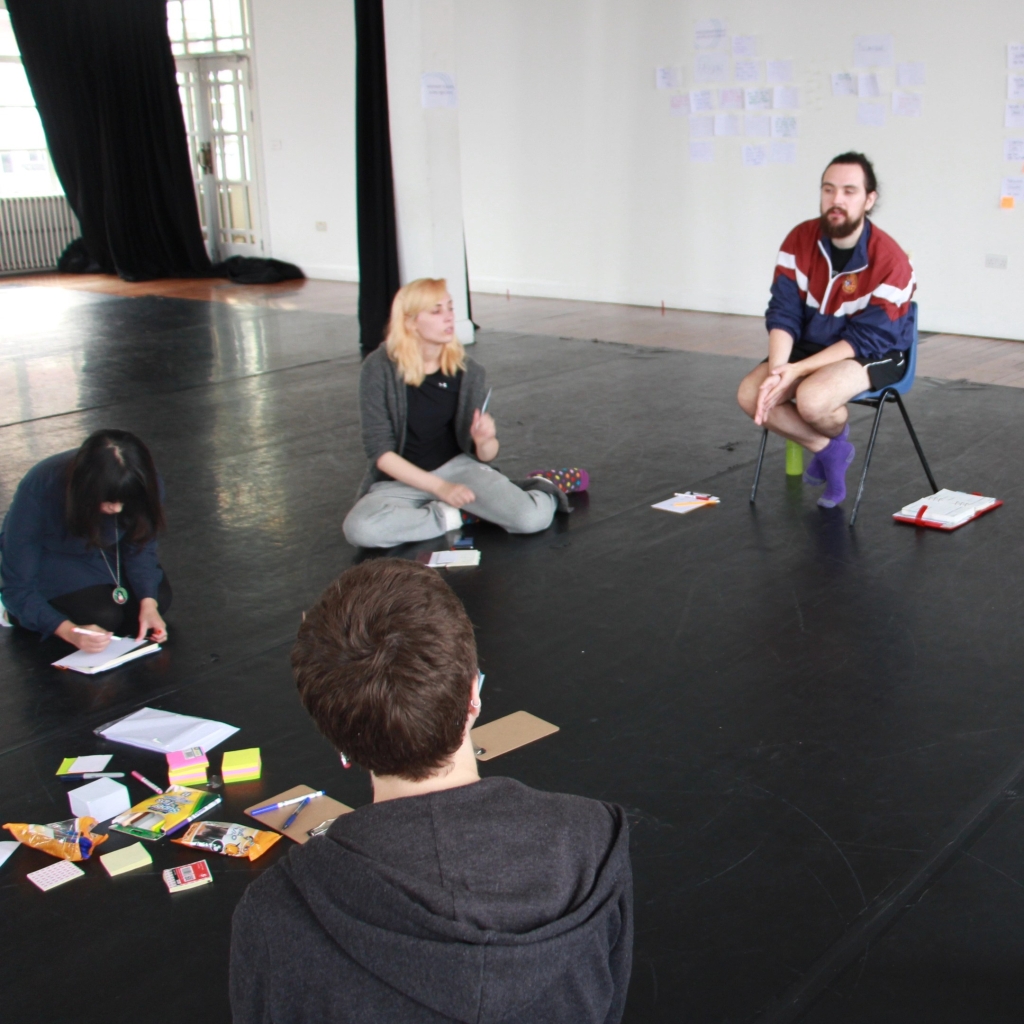
For the last five weeks, I’ve been working with The Collaboratory to devise a new physical theatre piece based on Federico García Lorca’s poem-play, Yerma. We’ve been experimenting as much with our process as with the piece itself, reinventing how we work together virtually every time we walk into the rehearsal room.

The Collaboratory (Emlyn Guiney, Maria Leigh, Erin Maxon) have a deeply-shared aesthetic and solid working vocabulary, born of a year’s worth of training, reading, theatre-going, and devising together. With The Collaboratory and our adventurous cast (Hannah Gaff, Marilet Martinez, Liz Wand), I have been stretching my own aesthetic and practices to embrace The Collaboratory’s dynamic physical performance style and a new creation process, and to further explore what it means to be a director of collaborative new work.

One of our process experiments was setting up some early rehearsals with just the ensemble, sans director. As difficult as that was for me, to try to catch up the next day and respond to what the ensemble had generated in my absence, it gave the cast an opportunity to try out ideas without the pressure of a director’s judgment in the room and also fostered an atmosphere of each actor taking responsibility for and having agency over her character choices.

Lily Janiak picked up on this atmosphere when she visited our rehearsal last week for an SF Weekly feature:

“In rehearsal, director Tasker functions less as the decider and more as an outside eye, letting the ensemble know how their ideas look and offering some guidance but ceding ultimate power to the collective.”

I’ve had many discussions with other directors and collaborators about power, ego, and vision. Often we talk about power and decision-making in two extremes: dictatorship vs democracy. Neither analogy is particularly useful to me; I’m not Tsar Director and I’m not President of the Rehearsal Republic either. We’re neither voting on character choices nor enforcing design decisions with martial law. Yes, there are times, even in the most collaborative process when the director decides “you stand there and do that.” And of course, there are times in the most hierarchical process when the director actively solicits contributions from writers, actors, designers. No matter what process I’ve adopted for any particular piece, “the best idea in the room wins,” whether it comes from my own brain or someone else’s, or if – best of all – at the end of the day, we can’t remember whose idea it was.

The truth is, no director wants to make every decision that goes into a performance. I need the brain and gut inside each of my actors to make impulsive choices that feed the artist and inform the piece. If I were to “direct” by insisting on controlling every decision, we’d have about five minutes of theatre to show you this weekend, and I might as well have spent the last month rehearsing a solo marionette show. (Which is not to say that puppet theatre can’t be completely enthralling –  it just doesn’t take into account the artistic impulses of the puppets.) But if the ensemble is collectively making artistic decisions – if I’m ceding my ultimate power – how do I earn the title “director?”

For Dirty Laundry, while the ensemble focused on developing individual characters, backstories, and relationships, I took on the big picture of how the action moves along, what storylines are highlighted, and the emotional arc of the piece. With input from the ensemble, I compiled the lines that resonated for each character into a performance text that laid out exactly what words we would say and in what order. I’m counting on the cast to tell me and show me what it feels like “inside” the piece, while I pay attention to what it looks like “outside” the piece. Together, we brainstormed and refined a “dramatic question,” Anne Bogart’s term for the central idea, or thesis, of a devised work. Measuring all our choices against the rubric of “does this action/line/movement support our exploration of the dramatic question?” provides an ego-less way to focus our choices and force us to choose the material that thematically belongs in in the piece. It also gives us more concrete and repeatable rules for creating and honing new material than if the focusing criterion was “whatever the director wants.”

Because here’s the truth: if I knew exactly “what I wanted” before I stepped into the rehearsal room, the whole thing would be very boring. For me, rehearsal is about finding what’s interesting and inspiring about the piece, supporting my collaborators as they dig into the challenges of their roles, responding impulsively to what lights me up, and telling the truth about what I’m seeing, hearing, and feeling onstage. The exact location on the spectra of vision, power, and collective decision-making varies from project to project; wherever we ultimately landed with Dirty Laundry, I know it kept me on my toes.

The Etymology of Secrets

SHHHHH. DON’T TELL.

For me, one of the most exciting things about working on Dirty Laundry with The Collaboratory is the opportunity to learn a new set of tools. My work as a director and playwright has been heavily text-focused, and I am eager to study the language of movement with my collaborators. At the same time, The Collaboratory’s laser-focused physicality has got them wondering about more deeply integrating text into their work. Together, we’ll bring our unique skills and meet in the middle to find a way to make language and physicality equal partners in Dirty Laundry.

One of my favorite ways to get into a project is to look at a theme as if I’m learning the word for the first time. This helps me to acknowledge my assumptions, trace back the ideas behind the word, and probably learn something new that I might have overlooked. Ultimately, it’s about starting from square one and making the idea fresh.

For example, what is “secret?” The word has been around in English since the mid to late 14th century – it’s secrette in Middle English, from the old French secret, which they borrowed from the Latin secretus, meaning “hidden.” The Latin can be broken down further by noting that secretus is the past participle of the verb sēcernere, “to separate” or “to set aside.” The Latin and French word displaced “native” Middle English words like diegol, doerne, roune, and hidel, which meant things like “dark” “hidden” and “secret counsel.”  So the idea of keeping secrets is an ancient one that has been around in many forms for millenia (as opposed to newer words like “cryonaut” which was added to the Oxford English Dictionary in 2011, after being coined by science fiction in 1968).  I’ll skip over the drama of the evolution of languages – that stuff is pretty fun for my linguistic nerd brain to play with, but right now we’re more interested in the drama of secrets and what the heck Middle English has to do with Dirty Laundry, right?

Right. So the basis of the idea of a secret has to do with setting something apart in order to hide it. Beginning with my assumptions instead of the word itself, I might have said something like “a secret is something you don’t want other people to know” – which is only one facet of secrets.

Now that I have a handle on where the word comes from, I want to look at all the different ways we use it. A quick trip to dictionary.com tells me secret can be an adjective or a noun – and it once was a verb, as in the idiom “secret something away,” though that usage is now “obsolete,” according to OED.

adjective

  1. done, made, or conducted without the knowledge of others: secret negotiations.
  2. kept from the knowledge of any but the initiated or privileged: a secret password.
  3. faithful or cautious in keeping confidential matters confidential; close-mouthed; reticent.
  4. 4.     designed or working to escape notice, knowledge, or observation: a secret drawer; the secret police.
  5. secluded, sheltered, or withdrawn: a secret hiding place.
  6. beyond ordinary human understanding; esoteric.
  7. (of information, a document, etc.)
    1. bearing the classification secret.
    2. limited to persons authorized to use information documents, etc., so classified.

noun

  1. something that is or is kept secret, hidden, or concealed.
  2. a mystery: the secrets of nature.
  3. a reason or explanation not immediately or generally apparent.
  4. 11.  a method, formula, plan, etc., known only to the initiated or the few: the secret of happiness;  a trade secret.
  5. a classification assigned to information, a document, etc., considered less vital to security than top-secret  but more vital than confidential, and limiting its use to persons who have been cleared, as by various government agencies, as trustworthy to handle such material.

This variety of definitions has got me thinking about all the different reasons why we keep secrets – and here’s where we make the leap from just having fun with linguistics to discovering something with some dramatic potential.  In #2, a secret password keeps an elite group elite. It’s about power and separating the initiated from the unworthy. In #4, the secret police do their work in the darkness to keep politics from interfering with what has to be done – or, on the other hand, to keep public opinion from holding them accountable to social mores and human rights. It’s about efficiency, directness, and autonomy. #5 conjures images of an eves-dropper behind curtains or a skeleton in the closet. In #9, there are some things that are secret because nobody knows – all of humanity is still looking for the answers to some mysteries. #11 makes me think of corporate espionage, ferreting out secrets to get the upper hand against an economic competitor. And in #12, those in the know classify dangerous information to prevent it from falling into the wrong hands. That’s a lot of different kinds of secrets!

Not to mention a few I’ve brainstormed on my own: keeping a secret because we’re ashamed of something we’ve done; because we are worried that others will judge us for something we say or believe; because we don’t want to upset someone with bad news; because we don’t want share good news in case someone spoils it with an unasked-for opinion; because we know knowledge is power and we don’t want to give anyone else leverage over us.

In Lorca’s Yerma, the laundresses are obsessed with the secrets of the main characters, and each of them knows different snatches of information that helps the audience piece together the big picture of what is happening. In our first week of rehearsal for Dirty Laundry, we’ll be dreaming about what secrets the laundresses are keeping, who knows what about whom, and which secrets will be revealed beneath the layers of clothing and muck.

For more about the project, including a really fun video of us doing laundry in odd places all around San Francisco, check out our IndieGoGo campaign.