Blog Archives

Editing Helen

megan helen mask closeup

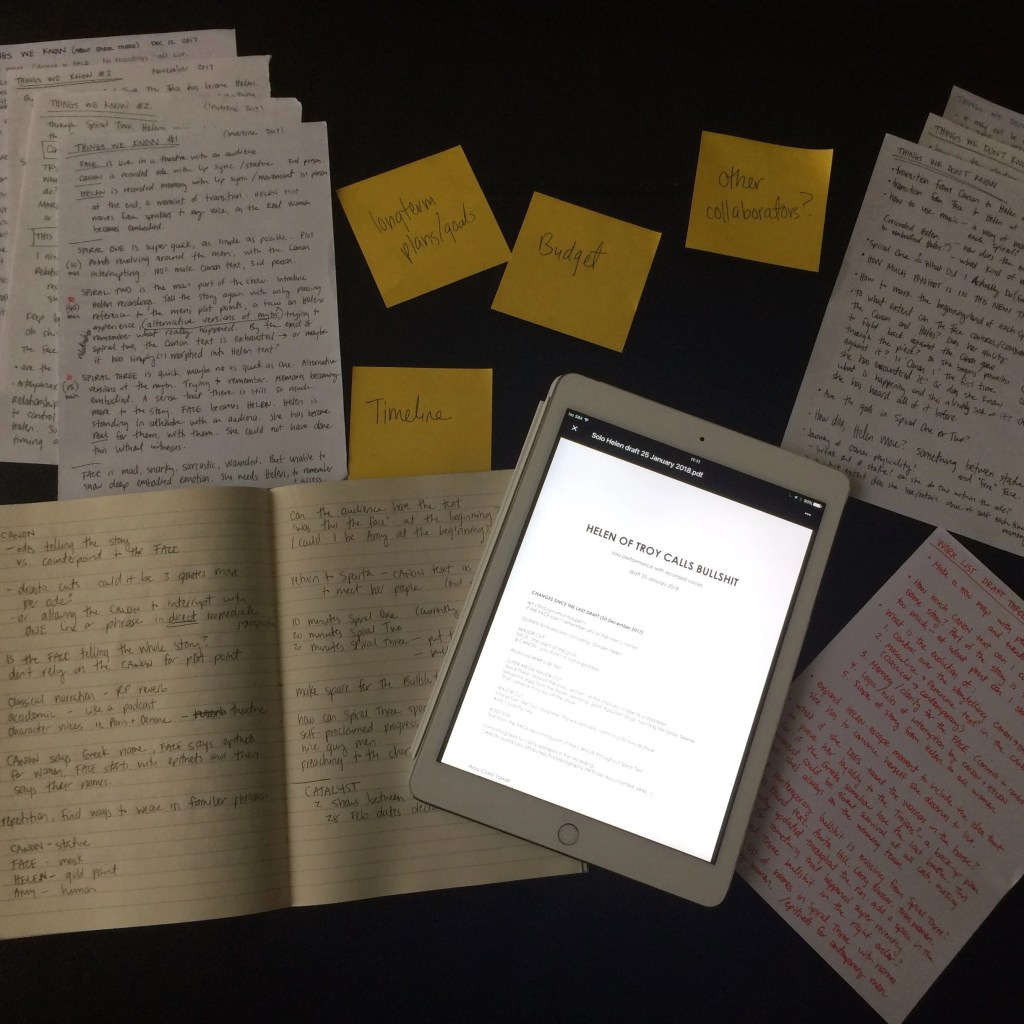
Megan surrounded by just a fraction of the text-in-progress for The Helen Project.

It’s been a while since I last gushed about the sublime insanity of collaborating with Megan Cohen on The Helen Project. We’ve been pretty busy gearing up for our developmental workshop at DIVAfest this May. In the last couple of months, we’ve revised our notion of who/when our five Helens are, tried out a few different approaches to performance styles with some delightfully adventurous women in an Actor Laboratory Day, had some epic meetings with our fabulous dramaturg Maura Halloran, thrown out entire sections of text that won’t fit in this iteration of the piece (with a greater sympathy for others who have tried to tame this unwieldy story before us – and with every intention of coming back to that mess of complexity in the post-workshop editing phase), cast five superb actors Misti Rae Boettiger, Sarah Moser, Ariane Owens, Roneet Aliza Rahamim, and Lily Yang, found a wonderful stage manager Julianne Fawsitt, scheduled rehearsals, taken some press photos at the Palace of Fine Arts between rain drops… and we’ve drunk a lot of tea. Tea is essential to our process.

Any one of those things could be an entire blog post. But in the interest of writing a current update ever again, that glossy summary is all you get. You can find more info on the Helen page of the DIVAfest website.

This photo is from a two-day intensive in the middle of February. Megan and I spent the entire weekend laying out more than a hundred fragments of text, one Helen at a time, putting 2-3 pieces together (and sometimes 8) into one larger piece that would be trimmed and reworked into something a larger. The goal was to reduce the number of movable parts in the Build-Your-Own-Helen Play Kit – and also to get the repetition of ideas under control. And also to remember what the hell we’d written over the last three years. Three years, you guys.

From there, we divvied up pieces that each of us would edit, and put those in the hands of actors for a few hours at our Laboratory Day. In three groups, we tried out different staging ideas, different rules of Helen’s world: can she hear the other Helens? Is she truly alone and isolated? Can each version of Helen only hear the Helens in her past? We learned a lot about our text, how long we want to listen to one person talking, how each Helen’s voice and perspective is different, and how The Face might start to fit into this world. Very special thanks to everyone who loaned us their brains and hearts that day:  El Beh, Misti Rae Boettiger, Kirsten Broadbear, Fontana Butterfield, Siobhan Marie Doherty, Maura Halloran, Allene Hebert, Heather Kellog, Luna Malbroux, Rami Margon, Ariane Owens, Annie Paladino, Roneet Aliza Rahamim, and Lily Yang.

Following the Laboratory, we’ve had some incredible dramaturgical meetings, rethinking the entire editing process (you take Helen 3 and 4, I’ll take Helen 2 and 5, see you in a couple of weeks), and taking a stab at building a trial edition of the Play Kit with post-it notes on Maura’s living room wall. (Frequent readers: I bet you could make up a drinking game with this blog and how many times I mention post-it notes. Enough times to give them their own tag, but that would make the game too easy.)

And now, with less than a month before we start rehearsals, what’s next? Burning through the rest of the editing, putting together a grab bag of found text fragments for The Face, hypothesizing some rules for the Kit, and building the First Edition of the text for the May 10 & 11 performances. Plus, starting this weekend, bouncing over to something completely different for a week: an experiment in how to make live theatre online via Google+ Hangout with local collaborators and an ensemble in New York City. Because why would I try out ridiculously complicated new ways of making a play just one at a time?

(r)evolving Images

Megan and I are getting pretty excited about our upcoming workshop of The Helen Project at DIVAfest this May! One of the many things on our to-do list – along with assembling our creative team, budgeting, brainstorming on the form and functionality of the “online interactive CyberJourney” and you know, continuing to write, edit, and create rules for the Play Kit – is figuring out how to talk to “real people” about the piece. Having begun work on this sucker nearly three years ago, it’s a real mental stretch to read our descriptions as if we know nothing about The Helen Project.

Last night, we sat in a Mission cafe for three long hours (no kidding) and came up with three very short paragraphs that explain what the heck we’re doing. It was exhausting and invigorating; we’ve come such a long way with Helen and it feels so satisfying to really get down to the essence of what the piece is becoming.

Nearly a year ago, I wrote a blog post using the image of a disco ball to describe our process of “collecting little bits that reflect something interesting, and sooner or later hoping it will assemble itself into a shape.” Last night, we picked up and discarded a number of similarly visual metaphors: portraits, mosaics, snapshots in an attempt to get “the whole picture” of who Helen is.

Finally we stumbled over the image of a kaleidoscope, and (after looking up how to spell it), everything clicked into place. I love this new image; it conjures a playfulness and curiosity along with a very directed view through lenses and mirrors. It honors the complexity and sophistication of the structure of the piece, as well as its randomness. Best of all, it captures the ever-changing view of Helen as the kaleidoscope turns. And for bonus points, the word is Greek, meaning “beautiful form to see.”

Interestingly, both disco balls and kaleidoscopes are basically cleverly-arranged mirrors – which has a lot in common with theatre, in a way. (read more about how kaleidoscopes work)

Here’s the new description:

The Helen Project zooms in and out of the bedroom and the mind of the most beautiful woman in the world. Creators Megan Cohen and Amy Clare Tasker will test their new Build-Your-Own-Helen Play Kit, constructing two different editions of the modular text to be performed over two weekends at DIVAfest.

Images of Helen from Homer and Goethe, from modern poetry, and even ripped from the headlines of our contemporary tabloids turn in a kaleidoscope of original and found text. We glimpse fleeting portraits of this mythic woman as each edition twists the mirrors to reflect a new Helen.

Like the text, Helen herself is fragmented. Five women – all Helen – crowd a bedroom, each making a decision that will change her life. Five Helens look into a mirror, asking, “is this the face that launched a thousand ships?”

Zeitgeisty Fragment Stuff

2012 has been a year of fragmentation, as I rearranged my life with a new job and new theatrical communities.

I’ve realized, too, that my artistic work has been in fragments lately:

  • Since February, Megan Cohen and I have been putting together our “Build Your Own Helen Play Kit,” made of fragments of identity, narrative, history, feminism, and epic poetry. (Check it out in May 2013 at DIVAfest!)
  • From June to November, The Strindberg Cycle kept me hopping among five plays that were part of a greater whole. Yes, I was astonished to discover that something so mammoth could also be fragmented.
  • In August, I worked with The Collaboratory to devise a new physical-theatre piece inspired by Lorca’s Yerma. The ensemble highlighted moments and ideas that appealed to them, and I took it all home to (re)arrange the script with some measure of cohesion out of those responses.
  • My play Phoebe & Theia was read last week at the SF Olympians Festival, structured around the Titans’ mythical fall to Tartarus. According to Hesiod, a bronze anvil falling from heaven would fall nine days before it reached the earth. The anvil would take nine more days to fall from earth to Tartarus. So the play was written in 18 fragments – and my writing process was fragmented, too, sneaking in an hour here and there between work and rehearsal for most of the last 5 months.
  • This week, I am directing for the One Minute Play Festival. I’ve got 10 plays to put together and cast however I please – it’s like a mini repertory project, and so fascinating to see how the plays resonate with each other, even though their authors may never have even met. My 10 plays are part of the larger festival, presenting 70 one-minute plays in one evening of theatre. Dominic D’Andrea, OMPF’s artistic director, describes the performance as 70 “pulses” of moments, brief windows into other worlds. The festival aims to reflect what is happening in the local theatre community here and now.

And now, at the end of 2012, I am doing what many news organizations and radio stations are doing: looking back on the last 12 months/52 weeks/365 days/525,600 minutes and trying to see those fragmented moments as somehow part of a larger whole, trying to find some cohesion in the chaos. Here in the age of Twitter, Google calendar, and compartmentalization, we all have too many balls in the air, we’re taught to break a problem into smaller parts to better see its solution, and we are living fragment to fragment.

Though I didn’t set out to respond to this phenomenon, I’m pretty pleased to discover this thread running through my work. As my delightful collaborators Annie Paladino and Megan Cohen put it last night, it’s “zeitgeisty.”

To Conquer Greece Again

Megan and I are pulling together found text for the incarnation of Helen we’ve come to call “The Face,” who speaks only in language handed down to her through the ages from epic poetry to contemporary academia. This poem is a contender for one of these found text Odes.

Helen of Troy
by Sara Teasdale, 1911

Wild flight on flight against the fading dawn
The flames’ red wings soar upward duskily.
This is the funeral pyre and Troy is dead
That sparkled so the day I saw it first,
And darkened slowly after. I am she
Who loves all beauty — yet I wither it.
Why have the high gods made me wreak their wrath –
Forever since my maidenhood to sow
Sorrow and blood about me? Lo, they keep
Their bitter care above me even now.
It was the gods who led me to this lair,
That tho’ the burning winds should make me weak,
They should not snatch the life from out my lips.
Olympus let the other women die;
They shall be quiet when the day is done
And have no care to-morrow. Yet for me
There is no rest. The gods are not so kind
To her made half immortal like themselves.
It is to you I owe the cruel gift,
Leda, my mother, and the Swan, my sire,
To you the beauty and to you the bale;
For never woman born of man and maid
Had wrought such havoc on the earth as I,
Or troubled heaven with a sea of flame
That climbed to touch the silent whirling stars
And blotted out their brightness ere the dawn.
Have I not made the world to weep enough?
Give death to me. Yet life is more than death;
How could I leave the sound of singing winds,
The strong sweet scent that breathes from off the sea,
Or shut my eyes forever to the spring?
I will not give the grave my hands to hold,
My shining hair to light oblivion.
Have those who wander through the ways of death,
The still wan fields Elysian, any love
To lift their breasts with longing, any lips
To thirst against the quiver of a kiss?
Lo, I shall live to conquer Greece again,
To make the people love, who hate me now.
My dreams are over, I have ceased to cry
Against the fate that made men love my mouth
And left their spirits all too deaf to hear
The little songs that echoed through my soul.
I have no anger now. The dreams are done;
Yet since the Greeks and Trojans would not see
Aught but my body’s fairness, till the end,
In all the islands set in all the seas,
And all the lands that lie beneath the sun,
Till light turn darkness, and till time shall sleep,
Men’s lives shall waste with longing after me,
For I shall be the sum of their desire,
The whole of beauty, never seen again.
And they shall stretch their arms and starting, wake
With “Helen!” on their lips, and in their eyes
The vision of me. Always I shall be
Limned on the darkness like a shaft of light
That glimmers and is gone. They shall behold
Each one his dream that fashions me anew; –
With hair like lakes that glint beneath the stars
Dark as sweet midnight, or with hair aglow
Like burnished gold that still retains the fire.
Yea, I shall haunt until the dusk of time
The heavy eyelids filled with fleeting dreams.

I wait for one who comes with sword to slay –
The king I wronged who searches for me now;
And yet he shall not slay me. I shall stand
With lifted head and look within his eyes,
Baring my breast to him and to the sun.
He shall not have the power to stain with blood
That whiteness — for the thirsty sword shall fall
And he shall cry and catch me in his arms,
Bearing me back to Sparta on his breast.
Lo, I shall live to conquer Greece again!

Helen’s Torch Song

Megan and I have been diving deep into researching the iconic Helen of Troy, the figure we immediately think of when we hear that famous line, “the face that launched a thousand ships.” We’ve been reading Homer, Marlowe, Goethe, Poe, Tennyson, and yes, Wikipedia. We’ve also discovered some wonderful modern poetry by Sara Teasdale and Margaret Atwood.

Here’s one we’re obsessed with at the moment:

Helen of Troy Does Countertop Dancing
by Margaret Atwood

The world is full of women
who’d tell me I should be ashamed of myself
if they had the chance. Quit dancing.
Get some self-respect
and a day job.
Right. And minimum wage,
and varicose veins, just standing
in one place for eight hours
behind a glass counter
bundled up to the neck, instead of
naked as a meat sandwich.
Selling gloves, or something.
Instead of what I do sell.
You have to have talent
to peddle a thing so nebulous
and without material form.
Exploited, they’d say. Yes, any way
you cut it, but I’ve a choice
of how, and I’ll take the money.

I do give value.
Like preachers, I sell vision,
like perfume ads, desire
or its facsimile. Like jokes
or war, it’s all in the timing.
I sell men back their worse suspicions:
that everything’s for sale,
and piecemeal. They gaze at me and see
a chain-saw murder just before it happens,
when thigh, ass, inkblot, crevice, tit, and nipple
are still connected.
Such hatred leaps in them,
my beery worshippers! That, or a bleary
hopeless love. Seeing the rows of heads
and upturned eyes, imploring
but ready to snap at my ankles,
I understand floods and earthquakes, and the urge
to step on ants. I keep the beat,
and dance for them because
they can’t. The music smells like foxes,
crisp as heated metal
searing the nostrils
or humid as August, hazy and languorous
as a looted city the day after,
when all the rape’s been done
already, and the killing,
and the survivors wander around
looking for garbage
to eat, and there’s only a bleak exhaustion.
Speaking of which, it’s the smiling
tires me out the most.
This, and the pretence
that I can’t hear them.
And I can’t, because I’m after all
a foreigner to them.
The speech here is all warty gutturals,
obvious as a slab of ham,
but I come from the province of the gods
where meanings are lilting and oblique.
I don’t let on to everyone,
but lean close, and I’ll whisper:
My mother was raped by a holy swan.
You believe that? You can take me out to dinner.
That’s what we tell all the husbands.
There sure are a lot of dangerous birds around.

Not that anyone here
but you would understand.
The rest of them would like to watch me
and feel nothing. Reduce me to components
as in a clock factory or abattoir.
Crush out the mystery.
Wall me up alive
in my own body.
They’d like to see through me,
but nothing is more opaque
than absolute transparency.
Look–my feet don’t hit the marble!
Like breath or a balloon, I’m rising,
I hover six inches in the air
in my blazing swan-egg of light.
You think I’m not a goddess?
Try me.
This is a torch song.
Touch me and you’ll burn.

The Outside Eye

For the last five weeks, I’ve been working with The Collaboratory to devise a new physical theatre piece based on Federico García Lorca’s poem-play, Yerma. We’ve been experimenting as much with our process as with the piece itself, reinventing how we work together virtually every time we walk into the rehearsal room.

The Collaboratory (Emlyn Guiney, Maria Leigh, Erin Maxon) have a deeply-shared aesthetic and solid working vocabulary, born of a year’s worth of training, reading, theatre-going, and devising together. With The Collaboratory and our adventurous cast (Hannah Gaff, Marilet Martinez, Liz Wand), I have been stretching my own aesthetic and practices to embrace The Collaboratory’s dynamic physical performance style and a new creation process, and to further explore what it means to be a director of collaborative new work.

One of our process experiments was setting up some early rehearsals with just the ensemble, sans director. As difficult as that was for me, to try to catch up the next day and respond to what the ensemble had generated in my absence, it gave the cast an opportunity to try out ideas without the pressure of a director’s judgment in the room and also fostered an atmosphere of each actor taking responsibility for and having agency over her character choices.

Lily Janiak picked up on this atmosphere when she visited our rehearsal last week for an SF Weekly feature:

“In rehearsal, director Tasker functions less as the decider and more as an outside eye, letting the ensemble know how their ideas look and offering some guidance but ceding ultimate power to the collective.”

I’ve had many discussions with other directors and collaborators about power, ego, and vision. Often we talk about power and decision-making in two extremes: dictatorship vs democracy. Neither analogy is particularly useful to me; I’m not Tsar Director and I’m not President of the Rehearsal Republic either. We’re neither voting on character choices nor enforcing design decisions with martial law. Yes, there are times, even in the most collaborative process when the director decides “you stand there and do that.” And of course, there are times in the most hierarchical process when the director actively solicits contributions from writers, actors, designers. No matter what process I’ve adopted for any particular piece, “the best idea in the room wins,” whether it comes from my own brain or someone else’s, or if – best of all – at the end of the day, we can’t remember whose idea it was.

The truth is, no director wants to make every decision that goes into a performance. I need the brain and gut inside each of my actors to make impulsive choices that feed the artist and inform the piece. If I were to “direct” by insisting on controlling every decision, we’d have about five minutes of theatre to show you this weekend, and I might as well have spent the last month rehearsing a solo marionette show. (Which is not to say that puppet theatre can’t be completely enthralling –  it just doesn’t take into account the artistic impulses of the puppets.) But if the ensemble is collectively making artistic decisions – if I’m ceding my ultimate power – how do I earn the title “director?”

For Dirty Laundry, while the ensemble focused on developing individual characters, backstories, and relationships, I took on the big picture of how the action moves along, what storylines are highlighted, and the emotional arc of the piece. With input from the ensemble, I compiled the lines that resonated for each character into a performance text that laid out exactly what words we would say and in what order. I’m counting on the cast to tell me and show me what it feels like “inside” the piece, while I pay attention to what it looks like “outside” the piece. Together, we brainstormed and refined a “dramatic question,” Anne Bogart’s term for the central idea, or thesis, of a devised work. Measuring all our choices against the rubric of “does this action/line/movement support our exploration of the dramatic question?” provides an ego-less way to focus our choices and force us to choose the material that thematically belongs in in the piece. It also gives us more concrete and repeatable rules for creating and honing new material than if the focusing criterion was “whatever the director wants.”

Because here’s the truth: if I knew exactly “what I wanted” before I stepped into the rehearsal room, the whole thing would be very boring. For me, rehearsal is about finding what’s interesting and inspiring about the piece, supporting my collaborators as they dig into the challenges of their roles, responding impulsively to what lights me up, and telling the truth about what I’m seeing, hearing, and feeling onstage. The exact location on the spectra of vision, power, and collective decision-making varies from project to project; wherever we ultimately landed with Dirty Laundry, I know it kept me on my toes.

Collective Consciousness – or having the same good idea as someone in 1778

I’ve been doing some image research, looking at neo-classical representations of Helen, and today I came across this:

Zeuxis Selecting Models for his Painting of Helen of Troy, by Angela Kauffman 1778

“According to the Roman author Pliny, the ancient Greek painter Zeuxis could not find a woman beautiful enough to represent Helen of Troy, the archetype of the feminine beauty, so he picked the best features of five virgins to compose the most ideal image of beauty.” Thanks to the blog Sedef’s Corner, which hosts what seems to be the only digital image of this painting readily available on all the Internets.

WHAT! That is a lot like what Megan and I are doing, or maybe it’s the inverse of what we’re doing – constructing a new vision of Helen by drawing on five different aspects of the character and personifying them in the bodies, minds, and mouths of five real women.

Fast forward a couple of millenia to 1778, when Swiss painter Angelica Kauffman created this image of the painter Zeuxis measuring and dissecting his five models, picking apart their best features to construct his own Helen of Troy. My favorite part of Kauffman’s version is that one of the models has taken up a brush and is about to sneakily render her own version of Helen. (Take that, patriarchy!)

I’m blown away by the power of collective consciousness – it’s amazing that thousands of years ago, Zuexis could have the idea to construct an aesthetic (if objectifying) ideal out of the best parts of women, and that 234 years ago Angelica Kauffman could have the idea to comment on that construction, and that right now this minute Megan and I are having ideas about constructing a new reality out of that ancient ideal, and/or a new ideal out of reimagining Helen’s reality… I can’t wait to see what happens when we get our build-your-own Helen up on the Internet for the world to construct with us!

Okay, what’s next?

I’m back from Directors Lab West! Helen of Troy is back! My days of hyper-dreaming with the brilliant Megan Cohen are back!

Every Saturday in June, Megan and I are back in our strange, surreal Helen-land, in which all things are possible and we’re going to take over the world. No kidding, it’s true. I am constantly amazed by how productive we are without even the hint of a roadmap. We met up for a delicious brunch on Saturday morning (inspiration covered in ketchup is the very best kind of inspiration), and by the time we’d finished our eggs, we had figured out a radical model of sharing this crazy new play so that director-dramaturgs of future productions would be constructing Helen just as much as we are, with our disco-ball moments organized into specific fragmented versions of Helen that can be played by 1 to 100 actors. Instead of publishing a script, we’ll make the construct-your-own-Helen-of-Troy PLAY KIT available online under a creative commons license. Every time I turn around, this thing gets even more out-of-the-box. I am so jazzed!

When we finished our tea and coffee, then we really got down to business. We never have a “plan,” but just asking “okay, what’s next” generates hours of incredible productivity. Between 11AM and 6PM, we reinvented our producing and publishing model, brainstormed on the online interactive component of the piece, dreamt about a 3-city simultaneous world premiere (12PM San Francisco, 3PM New York, 8PM London, all the time online everywhere oh my gods), and waded through about half of the 170 little bits of disco-ball text we’ve generated, beginning to structure the script into these 5 fragmented Helen characters (oh yeah, which we also defined that afternoon).

Who knows what we’re doing next time, but I bet it will be revolutionary.

Also coming up:

  • Dirty Laundry, a coproduction between Inkblot Ensemble and The Collaboratory. I’m directing this devised physical theater piece based on Federico García Lorca’s laundrywomen scene in Yerma, exploring themes of gossip, cycles, clean & dirty, sin & purity, and women’s work. August 10 & 11 work in progress performances at the EXIT Theatre.
  • Strindberg Cycle: The Chamber Plays in Repertory at The Cutting Ball Theater. I’m assistant directing these five plays (Storm, Burned House, Ghost Sonata, Pelican, The Black Glove) under Artistic Director Rob Melrose. We’re workshopping the new translations by Paul Walsh this June/July in RISK IS THIS…The Cutting Ball New Experimental Plays Festival, and you can catch the full production in October and November. This will be the first time the five Chamber Plays have been produced together in any language, including their original Swedish.
  • The San Francisco Olympians Festival is coming this December to the EXIT Theatre. If that feels far away, you can catch a few snippets on Friday, June 15 at Booksmith, where we’ll be celebrating the book launch of five published plays from the first year of the Olympians Festival. I’m writing a one-act about Phoebe & Theia, the Titan goddesses of light, and I’ll be directing Barbara Jwanouskos’ take on Hera later in the festival, too.

Directors Lab West: Day 2

I’m trying something new today with the blog: going to bed at night and getting up early to write. So that’s why this post is happening at 8AM and not 2AM. I’m also hoping that my brain has had a chance for synthesis while I was sleeping, and I can do a bit more than bullet-point reporting. Here goes!

I’m really appreciating the range of performances we’ve seen so far. On Saturday night, it was The Heiress at Pasadena Playhouse, then on Sunday afternoon, we visited Cornerstone Theater at the LATC for Cafe Vida, followed by Expulsion by Heidi Duckler Dance Theatre. We’ve barely had time to eat, let alone read the program before any of these performances started, so I’ve been having the unusual (for me) experience of going in blind as an audience member. All I knew about The Heiress was that it’s based on a Henry James novel and has a famous guy in the cast. All I knew about Cafe Vida was that it was a Cornerstone production, created with, by, and for a specific community using story circles and engaging first-time actors from that community, as well as professional actors, director and playwright. All I knew about Expulsion was that it was a free public performance in a vacant lot.

We had our first round-table discussion after Cafe Vida, and despite not being able to hear each other well in the busy LATC outdoor courtyard, this group of amiable, passionate directors began to argue for the first time. Now, now, unclench yourself, it’s okay to argue. We were responding to the rawness of Cafe Vida, the broadly drawn characters, a few soapbox speeches, and one delightfully “live theater” moment when a cockroach wandered across the stage and was stomped by the protagonist. (A fellow director later commented, “when that cockroach came onstage, I immediately thought, oh, someone is going to kill it and then we’re all going to clap.” Which is exactly what happened. There is nothing new under the sun…)

As a director, I strive for a sleek elegance in my work, in design and performance; it took me about an hour to adjust to the broad, unpolished rawness of the production. But after I did, there was still plenty of the show left to enjoy, and by the end I was moved to tears. There is so much to appreciate about Cornerstone’s work: the stories they tell are rarely, if ever, given a spotlight; they engage their community in the most visceral ways; their audience looks like a utopian dream – people from all walks of life coming together for two hours in a packed house on Sunday afternoon. The work is authentic, moving, and undeniably important. It is very different from what we have come to expect from “professional theatre” – a term that deserves more scrutiny, but I’m not going to go down that particular rabbit hole this morning.

Yesterday, we met artistic director Guillermo Aviles-Rodriguez of Watts Village Theater Company, whose Meet Me at Metro is a 2-4 hour site specific piece in which performers from various ensemble theaters guide audiences from stop to stop through the underground LA Metro transit system. His mission is to “make theater a verb, instead of a noun,” meaning that theater is an action, not a building. I am remembering a moment from the end of my Drama 120 Theatre History class at UC Irvine. Professor Cliff Faulkner (a delightful, inspiring fireball and one of my all-time favorite people) asked us “Do you want to create theater that is flashy and entertaining, or do you want to create theater that comforts people, or do you want to create theater that moves and challenges people, or do you want to create theater that causes a riot?” Cliff, this class was 6 or 7 years ago, so please forgive me for rewriting your lines based on my impression of them, rather than an actual memory of the words. This last part, I do remember verbatim: “The answer, of course, is YES.” Theater can do all these things and more – what do you want it to do?

So during our roundtable, in the midst of critiquing the acting style and lighting design, I wondered aloud to the group “What does theater do? If it is having a profound affect on the community of artists creating it, and the community from which the story has been revealed (a community that may not have ever been to theater before), do I, as a theater artist, or even as a “mainstream” audience member acclimated to “professional” theatre, need to have as deep an experience as the first-time actors onstage? Who is this piece of theater for? Obviously this piece is doing something much more important than entertaining me for a few hours.”

But, a good point from a colleague: “I don’t like the idea of qualifiers for art. Does the fact that these people have never done theater before excuse the roughness of the production? When the piece is presented in a theater space and I paid for a ticket, does the fact that it’s important have any bearing on whether or not it was good?” A fair question, and one that I’ve been asking myself in relation to the gender (dis)parity discussion happening in the American theater today. (But that’s another rabbit hole we’re not going to fall into right now.)

Remembering back to another course at UC Irvine, Bill Rauch (the founder of Cornerstone Theatre and now artistic director of the Oregon Shakespeare Festival) used to begin critique of our scene work in Directing 170 with the question, “What did you intend?” I think we have to judge a piece of theater by what it was trying to do, not by what we would have done as artists, not by the style of theater that we prefer, not by the stories we want to hear. Can we measure success by how fully the artists achieved their objectives, without passing judgment on the validity of those objectives? Would we judge a Picasso painting by how realistically it portrays a woman playing a mandolin? Of course not – and those who did in 1910 look like idiots now. We can simply acknowledge that a piece wasn’t to our own aesthetic taste, appreciate what we can of it, and make our own theater that is to our aesthetic taste. And thank goodness that we each have our own taste – how flat and barren would the field  be, if we were all doing the same work with the same intentions, style, and process!

Now that we’re had our first argument, and survived, I’m looking forward to more rigorous and respectful debate like our conversation yesterday. In fact, I had a beer last night with two of the people whose views and visions differ most widely from mine, and I am so grateful that we can have an amiable but challenging discussion, each articulating our ideas more clearly and questioning each other’s and our own assumptions. I don’t know that we’ll change each other’s minds, but that’s not our intention – and therefore not a criterion for success.

*

I’ll write again tomorrow, but in the meantime, you can check out another perspective on the Directors Lab West on the blog of my delightful coconspirator Wolfgang Wachalovsky. Directors Lab West itself is blogging about the lab, too – if you follow them on Twitter, you’ll be among the first to know when they post.

A Map of Helen’s Mind

Megan and I made a map so we wouldn't get lost inside our minds...